 By
By
8 Expert Ways to Maximize Space When Loading Your Skip
Loading a skip efficiently is like playing a high-stakes game of Tetris – every piece needs to fit perfectly to get the most value from your hire.
Poor skip loading can waste up to 30% of available space, forcing you to hire additional skips or pay for collection before your project is complete. With skip hire costs rising and environmental concerns growing, maximising every cubic yard becomes essential for both your wallet and the planet.
These techniques are based on waste management industry best practices and field-tested methods used by professionals to achieve optimal space utilisation whilst maintaining safety standards. This guide covers 8 proven strategies to transform your skip loading approach, from foundational techniques to advanced space optimisation methods that could save you hundreds of pounds on your next project.
1. Create a Solid, Level Foundation
Starting with flat, stable items at the bottom creates the structural foundation that determines how efficiently you can use the entire skip volume. A proper foundation can increase overall skip capacity by up to 25% by eliminating wasted space and preventing items from shifting during transport.
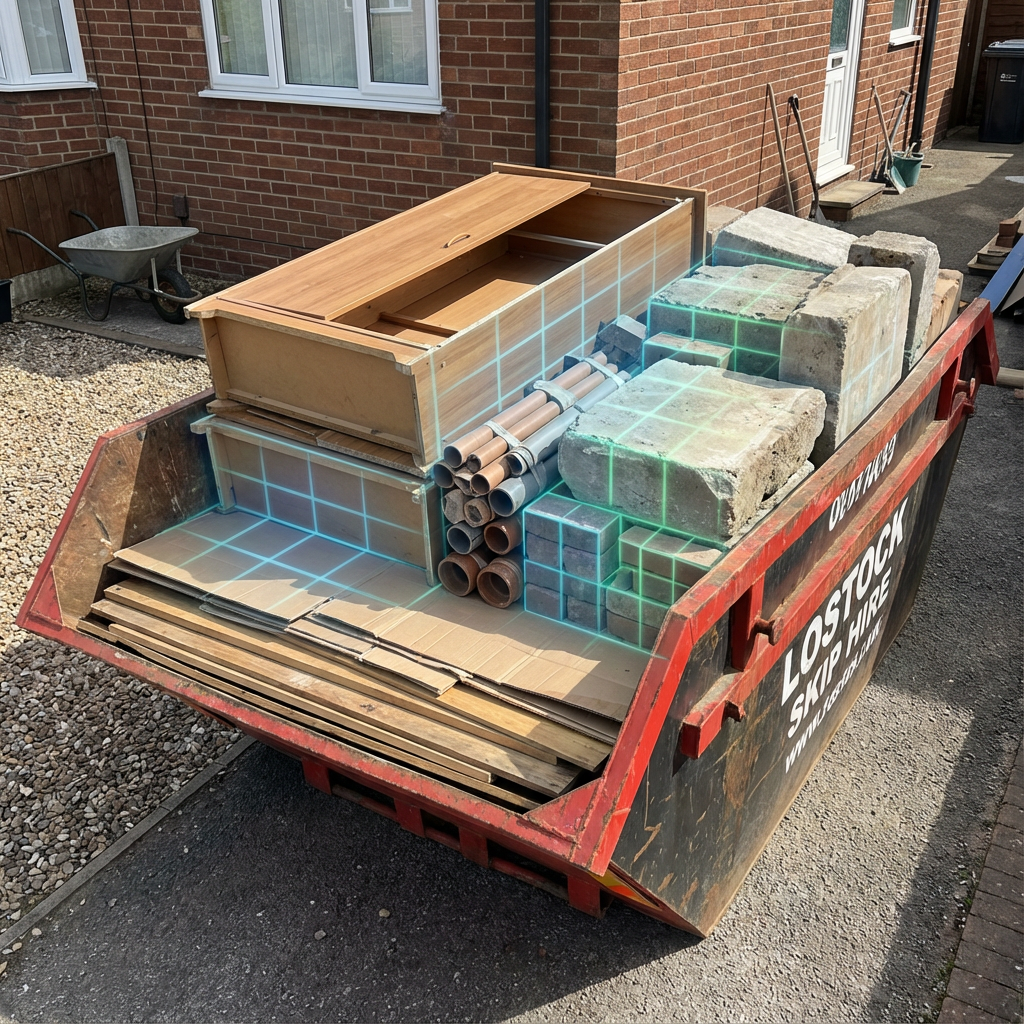
Use flattened cardboard boxes, thin wood panels, or plywood sheets to create your base layer. Ensure the foundation extends to all corners and edges of the skip, distributing weight evenly across the base and creating a level surface for systematic stacking. Professional waste managers report that skips loaded with proper foundations accommodate 20-30% more waste than those loaded haphazardly from the start. This technique prevents items from sinking into gaps or creating unstable layers that waste precious capacity.
2. Break Down and Dismantle Bulky Items
Systematically dismantling furniture, appliances, and large items before loading dramatically reduces the volume they occupy. Intact furniture can waste up to 60% of its skip space due to hollow areas and awkward shapes that prevent efficient stacking.
Remove doors, drawers, and separable components to eliminate air gaps, creating uniform pieces that stack and tessellate effectively. Use basic tools like screwdrivers and hammers to dismantle items safely, removing all hardware and separating different materials for recycling. A standard wardrobe that might occupy 8 cubic feet intact can be reduced to just 3-4 cubic feet when properly dismantled. The hollow areas can then be filled with smaller debris, maximising every inch of available space.
3. Master the Art of Tessellation
Arranging items to fit together like puzzle pieces eliminates gaps and maximises density, particularly effective with uniform items like bricks, tiles, or timber. Tessellating similar items can improve space efficiency by 40-50% compared to random placement, whilst creating stable layers for additional waste.
Group similar items before loading and rotate pieces to find optimal fit. Use the “brick-laying” principle with overlapping joints for stability. 100 standard house bricks randomly thrown into a skip occupy approximately 12 cubic feet, but when tessellated properly, they use only 7-8 cubic feet. This technique minimises air gaps between similar-shaped items and creates stable platforms for subsequent layers, allowing precise calculation of remaining space.
4. Utilise Strategic Weight Distribution
Placing heavy items at the bottom and sides, with lighter materials towards the centre and top, optimises both space usage and transport safety. Proper weight distribution prevents load shifting during collection. It allows you to safely fill the skip without exceeding weight limits.
Place concrete, bricks, and soil around the perimeter first, then fill the centre with lighter items like packaging or garden waste. Monitor total weight to avoid overloading fees whilst maintaining skip stability during transport. Skips with strategic weight distribution can safely accommodate up to 15% more total volume whilst staying within legal weight limits. This approach prevents heavy items from crushing lighter materials and maximises usable capacity.
5. Fill Every Gap and Void
Using loose materials like soil, sand, or small debris to fill spaces between larger items eliminates wasted volume and stabilises the load. Air gaps can account for 20-35% of skip volume in poorly loaded containers, representing significant wasted capacity and money.
Save soil, gravel, broken concrete, and small rubble specifically for gap-filling. Pour carefully to avoid overfilling, using a rake or stick to guide materials into tight spaces. A skip containing large items with unfilled gaps may utilise only 65% of its capacity, whilst gap-filling can achieve 90%+ efficiency. This technique transforms unusable air space into productive volume whilst preventing items from shifting during transport.
6. Employ Vertical Space Optimisation
Positioning long, flat items vertically against skip walls and using the full height efficiently maximises cubic capacity whilst maintaining stability. Many skip users only fill horizontally, wasting up to 30% of available vertical space that could accommodate additional materials.
Lean panels against walls at safe angles, securing loose vertical items with horizontal bracing. Ensure nothing protrudes above the skip rim to avoid additional charges or safety hazards. A 6-cubic-yard skip can effectively hold an extra 1-2 cubic yards of material when vertical space is utilised correctly. This approach accommodates awkward long items like fence panels or timber whilst creating compartments for different waste types.
7. Compress and Compact Loose Materials
Physically compacting soft materials and crushing hollow items reduces volume and allows more waste to fit safely within the skip’s capacity. Proper compaction can increase effective skip capacity by 15-25%, particularly important with bulky but lightweight materials like packaging or garden waste.
Use body weight or tools to compress layers systematically, wearing appropriate protective equipment for safety. Garden waste and packaging that fills a skip loosely can often be compacted to occupy 60-70% of the original volume. Avoid over-compaction that makes materials difficult to remove, and focus on creating stable, dense layers that prevent loose materials from blowing during transport.
8. Plan Your Loading Sequence
Loading items in the correct order – from foundation through bulky items to gap-fillers – ensures optimal space utilisation and prevents the need to reorganise mid-project. Poor loading sequence often requires removing and reloading items, wasting time and reducing final efficiency by up to 20%.
Sort waste before starting and follow this systematic sequence: flat base items, heavy materials, bulky items, tessellating materials, then gap-fillers. Keep small items aside for final space-filling. Professional waste contractors following systematic loading sequences consistently achieve 85-95% skip capacity utilisation compared to 60-70% for random loading. This approach eliminates the need for mid-loading reorganisation and ensures each item type goes in its optimal position.
These eight strategies work together to transform skip loading from guesswork into a systematic process that maximises every cubic yard of capacity. Start with techniques 1-3 for immediate improvement, then incorporate advanced methods 4-8 as your experience grows. Focus on the techniques most relevant to your specific waste types.
Implementing just half of these techniques typically increases skip efficiency by 35-50%, often eliminating the need for additional hires and reducing overall project waste costs. Before your next skip arrives, review these techniques and sort your waste accordingly – your project budget and timeline will benefit from this systematic approach to space maximisation.
| Technique | Primary Benefit | Best Waste Type | Difficulty Level |
|---|---|---|---|
| Solid Foundation | 25% capacity increase | All waste types | Beginner |
| Break Down Items | 60% volume reduction | Furniture/appliances | Beginner |
| Tessellation | 40-50% efficiency gain | Uniform materials | Intermediate |
| Weight Distribution | Safe maximum filling | Mixed waste | Intermediate |
| Gap Filling | 20-35% space recovery | Loose materials | Beginner |
| Vertical Optimisation | 30% additional capacity | Long/flat items | Intermediate |
| Compaction | 15-25% volume reduction | Soft materials | Beginner |
| Loading Sequence | 20% efficiency improvement | All projects | Advanced |