 By
We talk a lot about recycling.
So does almost every waste company.
But what does “recycled” actually mean?
Where does the wood go? What happens to the metal? What happens to the rubble you’ve thrown into your skip?
And perhaps most importantly, how do you know it’s actually being dealt with responsibly?
At Lostock Skip Hire, we think customers deserve to understand what happens to their waste after we collect it.
So let’s follow the journey.
It Starts When Your Skip Comes Back
When one of our wagons collects your skip, that’s the end of the job as far as most customers are concerned.
For us, it’s the start of another one.
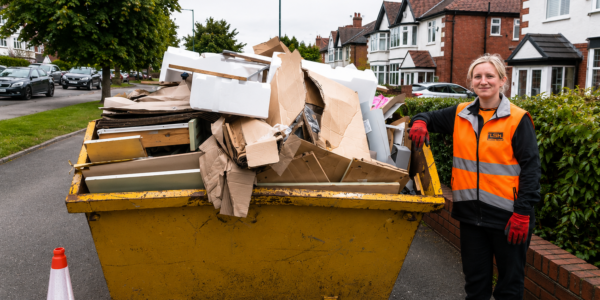
Your skip returns carrying a mixture of materials. Depending on the job, that could include timber, metal, rubble, cardboard, garden waste, furniture and general household or building waste.
It doesn’t all have the same destination.
The first job is working out what can be recovered.
Wood
Timber is a common sight in our skips.
Old fencing, floorboards, doors, broken furniture and timber from building projects can all end up mixed together.
Where suitable, wood is separated from the general waste stream so it can go on for further processing and recovery rather than simply being treated as rubbish.
Metal
Metal is one of the most obvious materials to recover.
Old fixtures, pipes, frames and other metal items can be separated from mixed waste and sent through the appropriate recycling process.
Unlike many waste materials, metals can potentially be recycled repeatedly, making their recovery particularly worthwhile.
Hardcore And Rubble
Building and landscaping projects can generate significant amounts of brick, concrete, stone and rubble.
Where suitable, these materials can be separated and processed for further use rather than automatically being treated as waste with no further value.
It’s a good example of something that might look like rubbish to the customer but can still have a useful life after it leaves their property.
Cardboard
Cardboard takes up a surprising amount of space in skips, particularly following house moves, deliveries, kitchen installations and commercial clearances.
Where it can be recovered cleanly, cardboard can be separated from other materials and sent into the appropriate recycling stream.
It’s also why we always encourage customers to flatten boxes before putting them into a skip. You’ll get considerably more into the space you’ve paid for.
Green Waste
Branches, plants, hedge cuttings and other garden waste are another common material we handle.
Where appropriate, green waste can be separated and processed through dedicated routes rather than simply being mixed with everything else.
What About Everything Else?
This is where we think it’s important to be honest.
Not everything put into a skip can be recycled.
Some materials may be contaminated. Others simply don’t have a practical recycling route available.
Responsible waste management isn’t about pretending everything can magically be turned into something new.
It’s about recovering what reasonably can be recovered and making sure what’s left is handled through the correct, licensed disposal routes.
Recycling Doesn’t Happen By Accident
Separating and processing waste requires people, machinery, vehicles, facilities and investment.
And all of that costs money.
It’s something customers don’t necessarily see when they’re comparing the price of one skip with another.
You see the skip.
We see everything that needs to happen to the contents after we’ve collected it.
It’s one of the reasons we’ve recently talked openly about increasing waste disposal costs and why the price of responsible skip hire isn’t simply the cost of delivering a metal container to your driveway.
Ask Where Your Waste Goes
We think this is a question more people should ask.
When choosing somebody to remove your waste, don’t just ask:
“How much?”
Ask:
“What happens to my waste afterwards?”
Whether you’re using Lostock or somebody else, it’s a perfectly reasonable question.
The cheapest way of making waste disappear isn’t necessarily the right way of dealing with it.
Once it’s been collected, it still has to go somewhere.
Your Waste. Our Responsibility.
At Lostock Skip Hire, we don’t believe our responsibility ends when your skip leaves your driveway.
It’s our job to manage what happens next.
That means recovering materials where we can, using the appropriate recycling and processing routes and dealing responsibly with the waste that remains.
We don’t think recycling should simply be a word printed on a website.
If we’re going to tell customers we’re committed to recycling, we should also be prepared to explain what that actually means.
Because your waste doesn’t disappear when we collect it.
Your waste. Our responsibility.